Although the initial purchase and installation costs
of a reciprocating compressor are greater than a rotary,
the reciprocating unit, with proper maintenance, lasts 2-5
times longer than a rotary design.
Over the decades, the reciprocating compressor has proven
to be a reliable workhorse. With advancements in material
technology, reciprocating units are improving intervals
between maintenance and providing quality air. When looking
at compressor applications outside of the 100-150 psig range
or compressing gases other than air, the reciprocating compressor
is usually the best choice.
Below 30 hp
The popularity of small air-cooled reciprocating compressors
dates back to the early 1900s. They have been used extensively
in applications requiring pressures up to 175 psig. Large
and small air-cooled units are well suited for use in harsh
environments.
The most common small reciprocating compressor is the single-acting
design. Operating temperatures can reach 380 F and most
units operate at sound levels above 80 dBA.
For lower horsepower applications, reciprocating compressors
are considered a good value because the initial purchase
price is generally 40-60% less than a rotary screw compressor.
It is important to note that optional components, such as
aftercoolers, starters, and operational components, such
as switches, are usually offered as price adders to a base
machine.
Small reciprocating compressors are durable machines that
provide reasonably good quality compressed air for many
applications. Their simplistic design, wide range of operation,
and overall proven reliability are the most significant
strengths.
Although the rotary screw compressor initial purchase cost
is greater than a reciprocating compressor, those in the
10-30 hp range are becoming popular. One reason is they
come as a complete package. In most cases rotary screw compressor
packages are equipped with a starter, aftercooler, and compressor
controller with diagnostic capability as standard equipment.
Rotary screw compressors are available in smaller sizes
ranging from 5-30 hp. One advantage over reciprocating compressors
of the same horsepower is they operate at cooler temperatures.
Screw compressors are designed to run at 100% duty cycle
and , due to low oil carryover, provide good quality compressed
air.
Installation
Small reciprocating machines should be used with an air
receiver. The receiver stores compressed air and minimizes
the loaded run time of the compressor. Some small reciprocating
compressorshave limited duty cycle of around 66%.
It is particularly important to the life of these compressors
to use an adequately sized receiver. No matter what the
receiver size or configurationof the compressor and receiver,
small reciprocating machines are relatively easy to install.
Any reciprocating compressor should always be anchored to
the floor due to unbalanced forces.
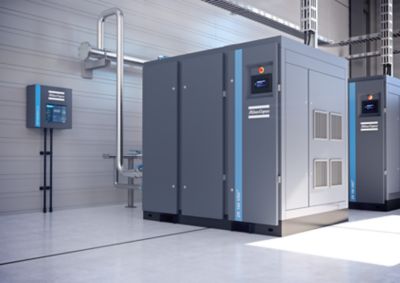
The majority of small rotary packages are designed to stand
alone. Base-mounted units can be mounted on top of an air
receiver. Air is discharged from rotary screw compressors
without pulsations. However, it is a good idea to include
a receiver in the system to smooth the control air signal
back to the compressor controller and provide consistent
operation.
Small rotary screw compressors offer the purchaser a good
value for a complete package that can be used in applications
demanding constant volumes of compressed air. Most enclosed
rotary screw units operate at sound levels well below 80
dBA. Packaged rotary compressors are easily installed by
using simple floor anchors, and generally have single-point
hookups for electrical and air connections.
Selecting the correct installation space for an air-cooled
compressor is an important factor for reliability and long
service life. Good airflow over the compressor pump is essential
for the unit to operate properly and extend service life.
Overall, compressed air quality from rotary screw compressors
is good. Even though the rotary can be an oil-flooded machine,
an efficient air/oil separator reduces oil carryover into
the compressed air system to less than 5 ppm. Air quality
is further improved by lower operating temperatures that
are inherent to the rotary design. Most rotary compressors
operate at approximately 100 degrees .F above ambient temperature.
Oil free, oil-less, or non-lubricated
Which compressor should be used in applications where air
or gas is required to be free from oil? Oil-free compressors
use some form of lubrication for bearings and gears, but
the compression area is free from oil.
Oil-free compressors are often rotary
screw. The oil-free machines, because of the lack of cooling
at the point of compression, can run at elevated operating
temperatures. Newer technology injects water into the compression
area to keep operating temperatures down and extend service
life. Rotary screw, oil-free compressors range in size from
20-260 hp and are used in applications of 150 psig or less.
Oilless reciprocating compressors are
used primarily for applications from 1-15 hp. Oilless compressors
do not use any oil in the entire machine.
Nonlubricated reciprocating compressors
are a viable selection for higher pressure or higher horsepower
applications.
---- Edited by Joseph L. Foszez, Senior Editor,
Plant Engineering
Reprinted from PLANT ENGINEERING, September 1998
© 1998 by CAHNERS BUSINESS INFORMATION
|